Reading 02 · The companion
Giotto
Further Reading & Selected Works
A modern orientation
The story of a renewal.
Cimabue brings the first light. Giotto, in Vasari’s telling, brings painting back to life. Read for the moments when a body, a gesture or a joke is made to prove that claim.
The shepherd drawing his sheep, the perfect circle and the painted fly make talent seem self-evident. Elsewhere, long lists of commissions, patrons and pupils reveal how much that talent depends on other people. This tension is a useful starting point for reading the Life.
The National Gallery’s overview identifies the Arena, Bardi and Peruzzi frescoes and the Ognissanti Madonna as central surviving works. Compare these with the uneven attention they receive in Vasari: length of description is no guarantee of historical certainty.
Where to pause in Vasari’s account
- Dates and the papal name. The text preserves Vasari’s birth date of 1276 and death date of 1336. Modern reference dates differ: the Uffizi gives 1267–1337, while the National Gallery gives about 1265–1337. “Benedict IX of Treviso” is also retained as printed; the Vatican identifies the Trevisan pope of 1303–1304 as Benedict XI. Do not use the Life as an uncorrected timeline.
- The Camposanto paintings. Vasari devotes vivid attention to Job’s servants and Giotto’s supposed precautions against damp. The Comune di Pisa’s museum account assigns the Stories of Job to Taddeo Gaddi. The passage remains valuable evidence of Vasari’s looking and his interest in technique, even when its attribution fails.
- The Arena is not a minor stop. The Scrovegni Chapel’s official account dates its frescoes to 1303–1305 and describes a programme extending from the lives of Mary and Christ to the Last Judgement. Vasari’s late, brief “Worldly Glory” reference does not adequately describe that surviving programme.
- One famous name can hide many hands. Vasari brings architecture, relief sculpture and an extensive family of painters under Giotto’s authority. The cathedral’s account of the campanile identifies Andrea Pisano and Francesco Talenti as his successors and credits Andrea and his workshop with its early reliefs. For painting, the National Gallery of Art catalogue shows how attribution must distinguish master, workshop and later scholarly reconstruction.
- A fresh view of the Bardi Chapel. In September 2026, Opera di Santa Croce announced completion of the restoration. Its account describes the paintings’ complex conservation history. Keep that history in mind when comparing today’s images with Vasari’s confident descriptions of expression and colour.
These are selective reading notes, not a complete attribution catalogue. Dates and links checked on 2 October 2026.
Look closely
Selected works
Begin with bodies, space and gestures. Then return to the claims Vasari makes for them.
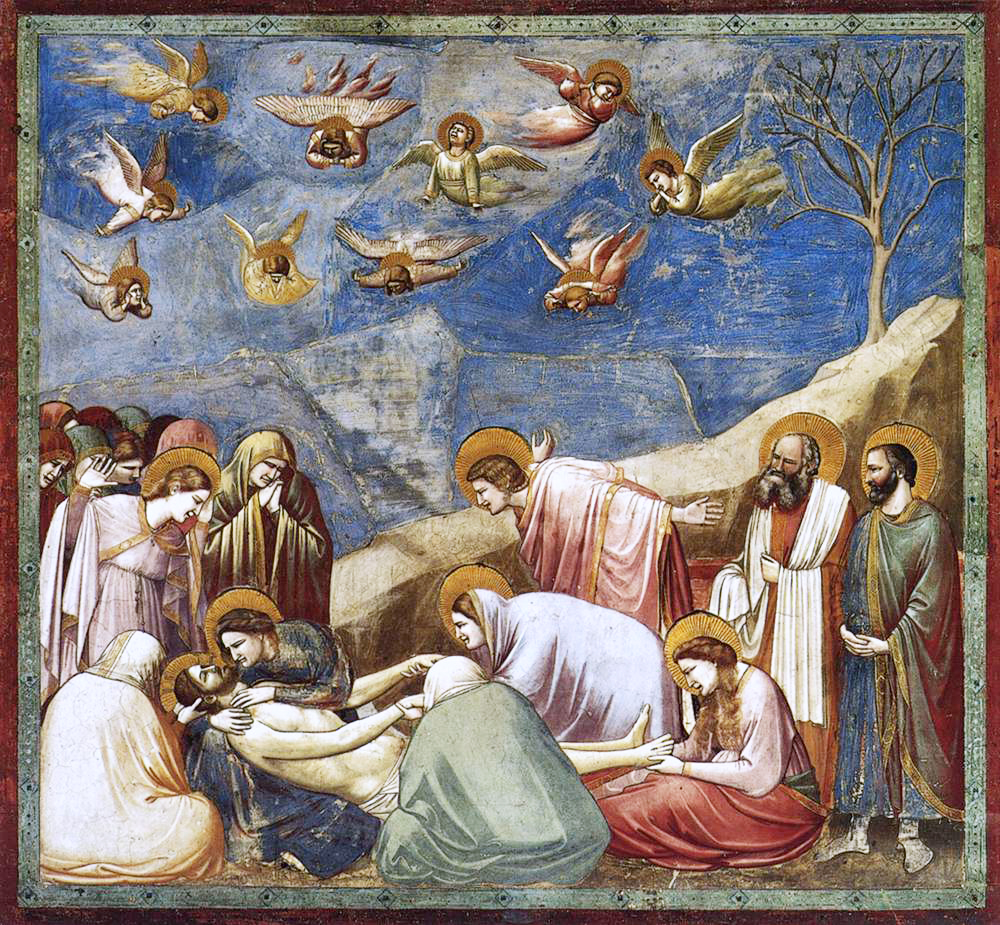
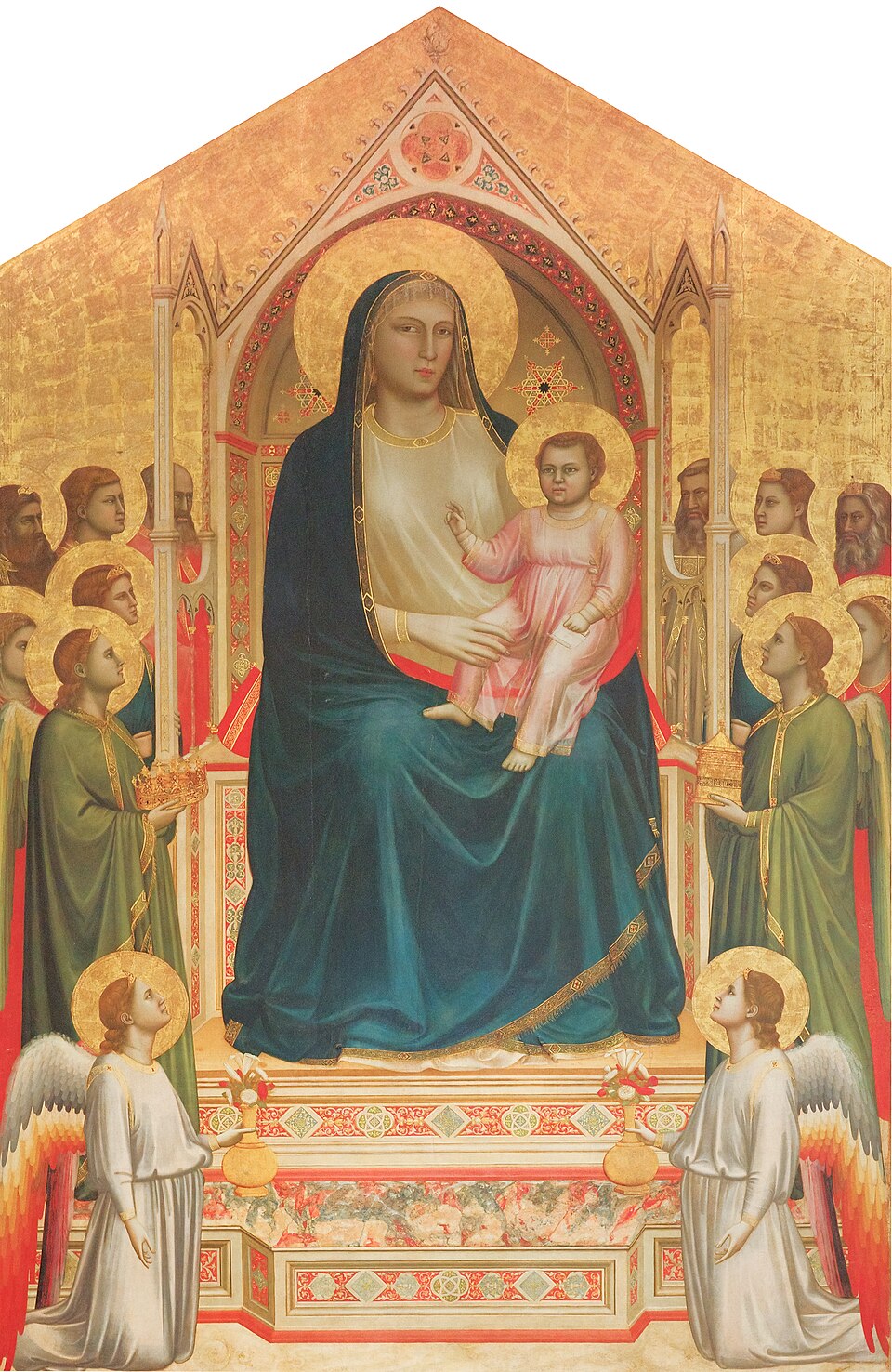
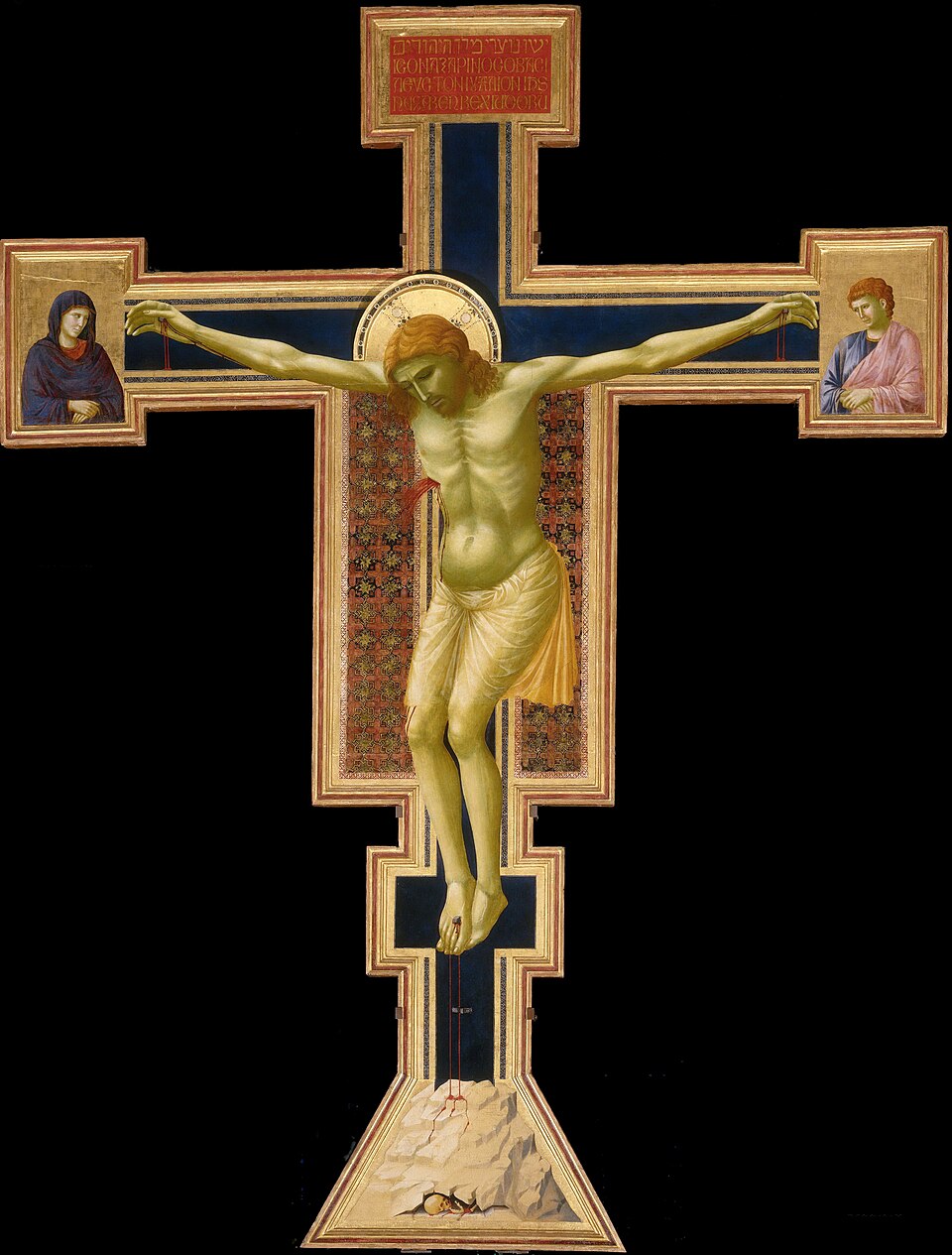
Images via Wikimedia Commons: Lamentation, Web Gallery of Art, adjusted by Amandajm (public domain); Ognissanti Madonna, photograph by Campocorvino (CC0); Crucifix, aiwaz.net (public domain). Museum dating is used above where it differs from image metadata.
_adj.jpg)


Scrovegni Chapel: Lamentation
Fresco, 1303–1305 · Padua. Vasari’s brief reference to a ‘Worldly Glory’ in the Arena gives little sense of this surviving cycle. The chapel’s official account describes its narratives of Mary and Christ, Virtues and Vices, and Last Judgement. Look closely at the Lamentation: the sloping rock directs the eye towards the two faces, while each mourner finds a different physical expression for grief.
02Ognissanti Madonna
Tempera and gold on panel, c. 1300–1305 · Uffizi, Florence (museum dating). Vasari names a Madonna with angels among Giotto’s works for the Humiliati. This is one of the firm anchors for studying his painting. Look at how knees, throne, overlapping haloes and the half-hidden saints make space tangible without abandoning the gold ground.
03Santa Maria Novella Crucifix
Painted wooden cross, late thirteenth century · Santa Maria Novella, Florence. Vasari locates it above the entrance and says Puccio Capanna helped. The church’s account identifies it as Giotto’s and traces its later movements; it now hangs in the nave. Compare its bodily weight and hanging arms with Cimabue’s Santa Croce Crucifix. Keep the question of workshop help separate from what looking alone can establish.
04Bardi and Peruzzi Chapels
Wall paintings, early fourteenth century · Santa Croce, Florence. These surviving cycles give substance to Vasari’s descriptions of mourning friars, dancing and resurrection. The Bardi Chapel tells the life of Francis; the Peruzzi Chapel the lives of the two Saints John. For the Bardi cycle, the newly completed restoration is a reminder that what a viewer can see depends on conservation as well as authorship.
05Assisi: the Franciscan allegories
Frescoes · Lower Church, San Francesco, Assisi. Vasari treats the vaults’ Poverty, Chastity, Obedience and Francis in glory as Giotto’s work. Use them to ask what the Franciscan patrons wanted the images to do, alongside the difficult questions of design, assistants and attribution. Julian Gardner’s study devotes a chapter to these vaults and supplies an appendix of their inscriptions.
06The bell tower of Florence Cathedral
Architecture and marble reliefs, begun 1334 · Piazza del Duomo, Florence. Vasari uses the tower to unite painting, sculpture and architecture under drawing and invention. The cathedral’s history gives a more distributed account: Giotto designed and began it, Andrea Pisano continued it, and Francesco Talenti completed it. The reliefs invite a direct test of Vasari’s account of the origins of the arts.
Continue